
As door panels grow larger and heavier, driven by wider glazing, multi-layer sealing systems and larger openings, the load rating of the roller system becomes one of the most important, and most overlooked, specifications in the entire door. A frame can be engineered correctly and the glazing specified to standard, but if the rollers beneath the panel aren’t rated for the load they’re carrying, the whole system is working under strain from day one.
What a Load Rating Actually Tells You
A roller’s load rating describes the maximum weight it’s designed to carry while maintaining smooth, consistent movement over its expected service life. This isn’t the same as the weight a roller can technically hold without immediately failing. A well-defined load rating accounts for repeated cycling, not a single static test, which is why two rollers with similar appearances can perform very differently once installed.
Ratings typically reflect:
- Load capacity, the maximum weight the roller can bear.
- Cycle life at rated load, how many open-close cycles the roller can sustain at the maximum capacity.
For large doors, load capacity and cycle life matter the most. A door isn’t just holding weight, it’s moving that weight repeatedly, often multiple times a day, for years.
Why Large Doors Push Load Ratings to the Limit
Large sliding doors, particularly those used in passive design, heavy commercial or industrial applications, carry more weight than standard residential or light commercial panels. Thicker glazing, multi-point locking hardware and reinforced framing all add mass that the roller system has to support without any increase in the resistance the door presents to the user.
This creates a common specification risk: a roller system that performs well on a standard-sized door can be pushed well beyond its rated capacity once panel size and weight scale up. The result isn’t usually immediate failure. It’s a gradual decline, rising resistance, uneven movement, and increasing wear on the track, that often isn’t traced back to the roller until the door is already underperforming.
What Happens When Roller Capacity Is Underspecified
When a roller system is operating close to or beyond its rated load, the effects compound over time rather than appearing all at once:
- Increased friction as bearings wear faster than designed
- Panel misalignment as uneven load distribution puts pressure on specific points in the track
- Seal degradation, as doors fail to close fully or evenly
- Shortened service life, requiring earlier replacement than the system was specified for
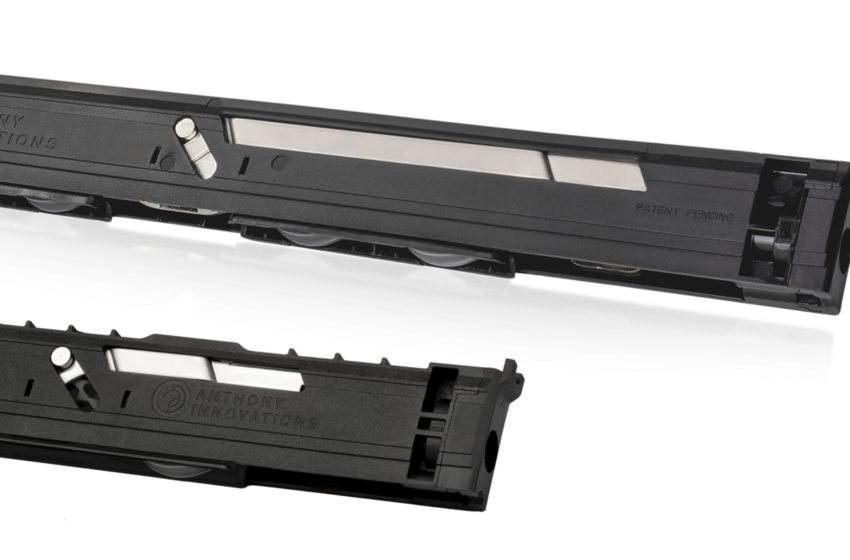
Anthony Innovations tests its heavy-duty roller systems against defined load and cycle thresholds rather than relying on theoretical capacity. The GIANTQuad roller for example, is tested to 10,000 cycles at its full 500kg per assembly rating, which reflects the gap this kind of testing is designed to close, the difference between a roller’s theoretical maximum and its reliable working load over years of use, particularly on large doors.
Matching Roller Capacity to the Application
Getting the load rating right starts with an honest assessment of panel weight, cycle frequency and site conditions, not just opening size. Anthony Innovations’ range is built around this principle, with roller systems positioned at different capacity levels rather than a single one-size-fits-all rating.
For commercial and high-end residential applications with moderate panel weights, the TraXtar™ Duo roller offers a 110kg roller capacity, suited to panels of up to 220kg, with a single bogie carriage design for balanced load distribution.
Stepping up in capacity, the 8000 Series roller carries a 160kg load rating, supporting panels of up to 320kg. It’s built for larger commercial doors that exceed what a standard-duty roller can reliably support over time.
For the largest and heaviest doors, the GIANTQuad is rated to carry 500kg per assembly, supporting panels of up to a 1 tonne panel, and has been tested to 10,000 cycles at that capacity. This tier is suited to major commercial openings and architectural applications where panel size and weight sit well beyond typical specifications.
Matching the rating to the actual application, rather than defaulting to the highest-capacity option, is what keeps the system both reliable and cost-effective.
Long-Term Reliability and Load Capacity
Roller capacity isn’t only a day-one specification question it determines how a door performs across its full service life. A correctly rated system maintains consistent movement and alignment for years, while an underspecified one shows performance decline within a much shorter window, regardless of how well the rest of the door was built.
For architects, builders and specifiers, this makes load rating one of the highest-leverage decisions in the entire door specification, disproportionate to how much attention it typically receives relative to frame and glazing choices.
With decades of experience in precision engineering, Anthony Innovations designs and tests roller systems against defined load and cycle ratings for demanding architectural and industrial applications. From the TraXtar™ Duo through to the 8000 Series and GIANTQuad, the range reflects that approach directly. Each tier is engineered to carry its rated load reliably, rather than stretching a single system beyond its intended range.