
As commercial buildings place greater demands on every moving part of the envelope, sliding door systems are being scrutinised more closely than ever. Cycle life, load handling and long-term reliability are now essential considerations, not afterthoughts, in facilities that rely on constant door movement throughout the working day.
Loading docks, warehouses and high-traffic retail entries all share a common challenge: doors that are opened and closed hundreds of times a day, often carrying heavier panels than a standard commercial fit-out would require. While attention typically focuses on frame size and glazing options, the internal hardware, particularly the roller and track system, is what determines whether a door holds up under that volume over time.
Why Heavy Commercial Sites Push Sliding Doors to Their Limits
Heavy commercial and industrial environments are built around different demands to standard commercial fit-outs:
- High cycle frequency, often hundreds of openings per day
- Heavier panel loads, driven by wider spans or reinforced glazing
- Exposure to dust, temperature variation or moisture, depending on the site
- Long service life expectations, frequently spanning a decade or more
Sliding doors in these environments must meet this standard while remaining easy to operate. Unlike a low-traffic entry, a heavy commercial door is in near-constant motion, and even small increases in friction or misalignment compound quickly into failures.
Common performance issues in underspecified systems include:
- Rising resistance as components wear
- Panel misalignment from uneven load distribution
- Track and roller wear from repeated heavy cycling
- Increased downtime as doors become harder to operate
These issues rarely start as major faults. They begin as small inefficiencies in the hardware that, left unaddressed, escalate into full system failures.
What Defines a Heavy-Duty Sliding Door System
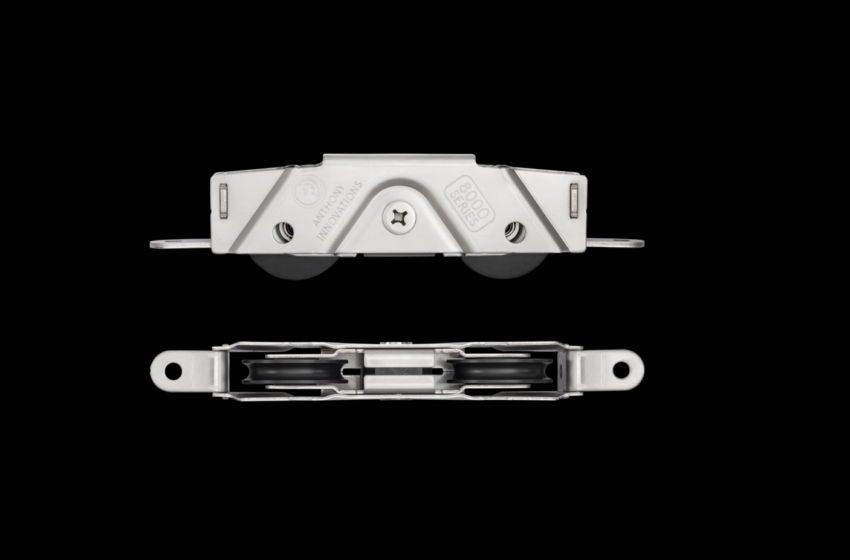
Not every sliding door system is built for high-cycle commercial use. Systems designed for this environment, like the 8000 Series roller, are typically defined by a few key characteristics:
Reinforced frame and track design Supports wider spans and heavier panels without deflecting under load.
High load capacity Rated to carry panel weights common in commercial and industrial glazing.
Sealed, precision components Reduce the ingress of dust and grit, particularly relevant on sites near loading areas or unsealed yards.
Dual-wheel carriage systems Distribute panel weight across the track rather than concentrating it at single roller points, reducing wear.
These features allow a system to function as a working part of daily site operations, rather than a component that requires frequent servicing to keep pace with demand.
None of this is about extra features for their own sake. Each spec addresses a specific failure mode that shows up in high-traffic commercial doors, and that reflects Anthony Innovation’s approach to the category: solve the failure mode first, then build the feature around it. It’s the difference between a door that lasts five years and one that lasts fifteen.
Reduced Friction, Reduced Downtime
Low friction in a heavy-duty door system isn’t only a usability benefit, it has a direct bearing on operating cost. Reduced resistance means less strain on tracks and drive components, fewer alignment issues over time, and a lower likelihood of the door failing to close fully.
For a commercial site, a door that won’t close properly isn’t a minor inconvenience. It’s a security gap or an operational stop until it’s repaired. Systems engineered for low friction and high load capacity, like the 8000 Series, are built specifically to reduce how often that happens.
Durability, Maintenance and Lifecycle Performance
For facilities managers and specifiers, door performance needs to be assessed over years, not months. Component quality has a significant bearing on lifecycle outcomes, including:
- Reduced maintenance and adjustment requirements
- Lower risk of drag, binding or premature failure
- Fewer service callouts and remedial works
- More predictable performance across the system’s working life
Viewed over the full life of the system, investing in a heavy-duty system built for the actual traffic volume it will face tends to outperform a lighter-duty system chosen on upfront cost alone.
Where the 8000 Series fits
The 8000 Series suits any site where the door is a working part of daily operations rather than an occasional-use entry point:
- Warehouses and distribution centres with regular forklift or pedestrian traffic
- Cold storage facilities, where sealing and cycle rating both matter
- Loading docks with high-frequency openings throughout the day
- Retail and hospitality entries with heavy foot traffic
It’s not the right fit for every application. For low-traffic internal doors or light commercial fit-outs, a lighter system will do the job for less. The value of the 8000 Series shows up specifically where volume and reliability are the priority, not where budget is the main constraint.
Get the right door for your site
Specifying a heavy commercial sliding door comes down to matching the system to the actual traffic and environment it’ll face, not just the opening size. The 8000 Series is built for high-cycle, high-load commercial environments, and it’s the option we recommend when a client’s site fits that description.
If you’re not sure whether the 8000 Series is the right call for your project, send through your site details, expected traffic volume, and any environmental factors like temperature or exposure. We’ll confirm the right specification, backed by Anthony Innovation’s engineering, and put together a quote.